It usually starts as a suspicion. A tree that came into leaf late last spring and has barely bothered this year. Bare branches where there used to be canopy. Sooner or later the question shifts from whether the tree is struggling to whether it ought to come out altogether.
Most people assume the answer is yes, and often it is. But not always, and not always straight away. A dead tree at the back of a large block is a very different proposition to one leaning over a driveway, and in a surprising number of places you are not free to remove either one without asking the council first.
Here is how to work out which situation you are in.
Request Quote: 131 546
Making Sure The Tree Is Actually Dead
Trees drop leaves, lose limbs and look thoroughly finished for reasons that have nothing to do with being dead. Drought stress, transplant shock, a hard winter or a bad pruning job can all produce a tree that looks beyond saving and recovers perfectly well the following season. Removing a tree that was only struggling is an expensive, irreversible mistake.
Three checks will tell you most of what you need to know.
The Scratch Test
Lightly scratch the bark of a twig or small branch with a fingernail or knife. Green and moist underneath means that part of the tree is alive. Brown and dry means it is not.
Test several branches at different points around the tree, because a couple of dead twigs on an otherwise healthy tree is normal.
The Snap Test
Bend a twig back on itself. A living twig is flexible and will bend before it breaks. A dead one snaps cleanly with no resistance.
Look at the Trunk and Base
Deep cracks, splitting, and bark peeling away in sheets all point to a tree in serious trouble. Fungi or mushrooms growing at the base or out of the trunk usually mean decay is already well advanced inside the wood. Branches with no living buds anywhere along them are another sign.
If a tree fails all three, it is almost certainly dead. Some species are harder to read than others and have their own particular warning signs, so if you are unsure, it is worth getting an arborist to look at it rather than guessing.
The Risk Underneath It
A dead tree on its own isn’t dangerous. However, it becomes dangerous when something valuable is within falling distance of it. Arborists think about this as the target: the thing that gets hit if the tree, or part of it, comes down.
A dead gum standing in the middle of a paddock, well clear of anything, presents very little risk to anyone. The same tree twelve metres from a bedroom window is a different matter entirely. Neither the species nor the fact of being dead tells you much on its own. The position does.
Work out what sits inside the fall zone, which is roughly the height of the tree in every direction:
- Houses, sheds, garages and fences
- Driveways, paths and anywhere people regularly walk or park
- Play equipment, pools and outdoor areas
- Power lines and service connections
- Neighbouring property, which carries its own liability
- Roads and footpaths
The more of that list sits under the tree, and the more often people are there, the more urgent removal becomes. A dead tree over a rarely used back corner can often wait for a planned job. A dead tree over the spot where the kids leave their bikes cannot.
When Removal Is Urgent
Some situations leave no room for deliberation.
The tree is already failing: A visible lean that was not there before, lifting or cracked soil on one side of the base, or a split running down the trunk all suggest the tree is in the process of coming down rather than waiting to.
Large limbs are hanging or have already dropped: Dead wood does not shed politely. Limbs come down in still weather as readily as in storms, which is what makes them dangerous.
It’s near power lines: Never attempt this yourself and never let an unqualified operator near it. Contact your electricity distributor if the tree is touching or close to lines.
It’s in a bushfire-prone area: A standing dead tree is dry, and dry standing timber close to a house is fuel. Most states have bushfire exemptions that allow removal for defendable space, though the rules on what you can clear and how close vary.
If a tree has already come down or is obviously about to, that is an emergency tree removal rather than a job to book in for next month.
When A Dead Tree Can Stay
A dead tree that threatens nothing is not automatically a problem to be solved, and in ecological terms it is often worth more standing than gone.
Dead and hollow-bearing trees are some of the most valuable habitat in the Australian landscape. Hollows form slowly, through decades of decay, fungal activity and insect damage, and the large hollows that bigger birds and mammals need can take well over a century to develop.
Nothing replaces them quickly. Planting a sapling does not compensate for removing a hollow-bearing tree in any timeframe that matters to the animals using it.
If the dead tree poses no risk, sometimes it’s better to leave it. That said, if the tree poses some risk but still provides habitat value, we often look for a middle ground.
This can look like reducing the tree to a safe standing height rather than removing it entirely. We’ll remove the limbs and shorten the trunk, which lowers the risk substantially while keeping the hollows and standing timber in place. This isn’t suitable everywhere, but it is a real alternative and one that many property owners are never offered.
The same logic applies to the timber on the ground. Fallen logs left in a back corner provide habitat too, and mulch from a removed tree can go straight back onto the garden.
What About Pests and Disease?
Dead wood does attract insects, and this is worth understanding properly rather than as a blanket warning.
Most of the borers and beetles that colonise dead timber are decomposers. They are doing the job they exist to do and pose no threat to the healthy trees around them. Their presence is not a reason to panic.
Termites are the genuine concern, and only in a specific circumstance: a dead tree or stump close to a house gives a colony a foothold near the structure. If a dead tree is near your home, factor that in.
Similarly, if the tree died from a transmissible disease, removing it can protect nearby trees of the same species. An arborist can tell you which category it falls into.
You May Still Need A Permit
Not having a permit before removing a dead tree is a mistake that often catches people off guard.
It’s a common assumption that a dead tree is exempt from council protection. It often is not. Many councils require a permit to remove a protected tree, whether it is alive, dead, or even a listed weed species. The protection attaches to the tree, not to its health.
Where the tree does present an immediate danger, most councils have an exemption that lets you act. But those exemptions are usually narrow. They tend to require that the risk is genuinely immediate rather than eventual, that only the hazardous part is removed, and that you can produce evidence afterwards. Photographs taken before the work and a written assessment from a qualified arborist protect you if the question is ever asked.
Penalties for removing a protected tree without approval are substantial, and in many council areas both the property owner and the contractor can be held liable. A tree service willing to take a protected tree down without checking is a liability rather than a bargain.
Before any work starts, check what applies to your address.
Our council regulation guides cover the rules across a range of council areas, and our tree removal permit guide walks through the application process. Your local Jim’s Trees can also check the position for you before quoting.
Getting it Removed Properly
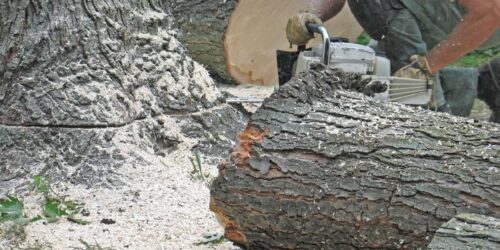
If removal is the right call, it’s not a job to take on yourself. Dead trees are considerably less predictable than living ones. The wood is brittle, decay inside the trunk is invisible from outside, and a tree that looks solid can fail in a direction nobody expected partway through the cut. It’s why DIY tree removal risks are higher with dead timber than with almost anything else.
A professional tree removal takes the tree down in sections where access is tight, works around whatever sits underneath it, and deals with the stump while the crew and machinery are already on site. Leaving a stump behind means a second visit later, and a dead stump close to the house brings its own termite considerations.
For more on assessing a hazardous tree, see our guide on when to remove a dangerous tree.
The Short Version
Confirm the tree is dead, not just struggling. Work out what falls within its reach, because that determines the urgency. Act immediately if it is failing, dropping limbs, near power lines or in a bushfire area. Consider keeping it, or reducing it to a safe height, if it threatens nothing and has habitat value. Check the permit position before cutting anything, because being dead does not necessarily make a tree fair game.
Not sure which of those describes your tree? Our qualified arborists can assess it, tell you honestly whether it needs to come out, and handle the council side if a permit is required. Call 131 546 or request a free quote online.